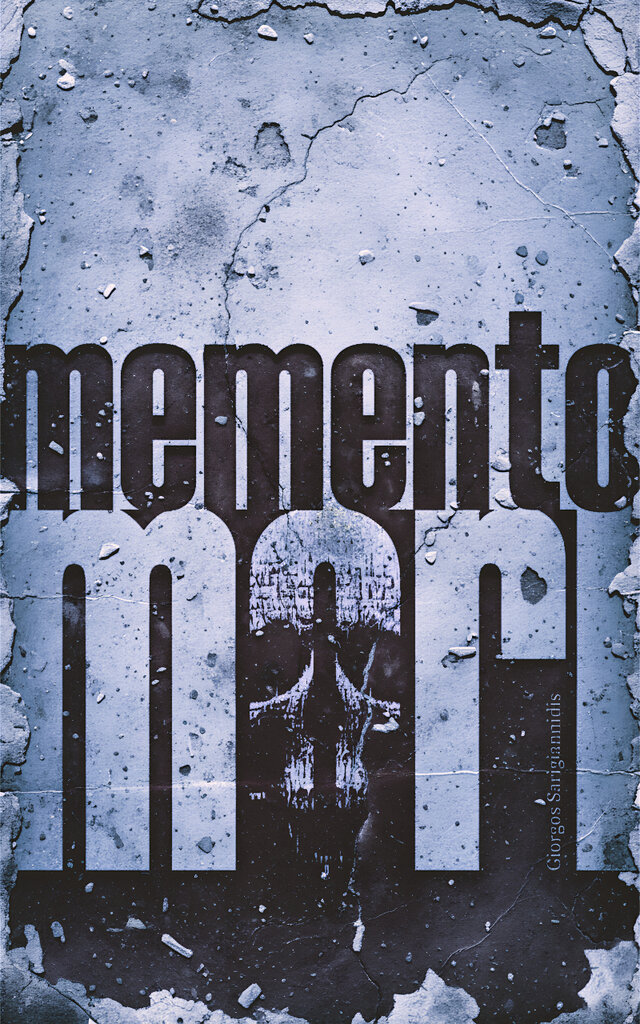
Memento Mori
Spoiler warning: these notes discuss the plot of Memento Mori.
The Book Started as a Reddit Joke
The whole idea for Memento Mori started as a joke on Reddit. In the r/SideProject community, someone had posted: “I’m feeling like I’m wasting my life so wrote a script that sends me an email everyday telling me how many days I (probably) have left to live.” I replied with this:
That would be a nice script for a movie: the protagonist somehow (mystical forces are involved in the process) writes a script that can accurately predict when its user will die. So, when he tests it, it says that he will die in 5 days. And he does, in a horrific accident. But he publishes the script on GitHub before he dies, and people start using it. After some more incidents which cannot be a coincidence, they figure out that it actually works and everybody freaks out now that they have a way to know their death date. Cults are formed, people start celebrating their deathday same as their birthday, insurance companies utilize it to maximize profits, some people commit suicide at the exact same date making it a self fulfilling prophecy, others try to kill themselves before their deathday only to realize that it isn’t possible. The movie ends with all the users of the script receiving the same deathday, hinting at the end of the world.
At first, I had no intention of turning it into a story. As time passed, I decided to make it a short story, which would essentially be composed of the chapters “Josh” and “Viral.” But as I started writing it, I became curious about Josh’s friend, who evolved into Jen, the protagonist of the book. And the short story turned into a full novel.
🔗 Read the original comment on Reddit: r/SideProject
The Athens Accident
In the opening scene of Josh’s chapter, he witnesses a disturbing accident on an Athens sidewalk: a scooter strikes a pedestrian, leaving him with a grotesque wound. As a crowd gathers, Josh stares on in numb detachment.
This moment comes from real life. The scene was inspired by a very similar accident I personally witnessed on the streets of Athens, and I drew on that memory to capture the surreal shock of it.
The naked Arab warrior drinking blood from the neck of his fallen enemy
In the chapter “Transcription,” Brother Thomas witnesses a terrifying scene during the siege of Constantinople: a gigantic Arab warrior charging naked across the battlefield with a massive sword in one hand, holding the severed head of a Goth in the other, and drinking blood from the neck of his fallen enemy.
While this scene sounds far-fetched, it is directly based on eyewitness testimonies from the Battle of Constantinople in 378 AD. The contemporary Roman historian Ammianus Marcellinus recorded that a Saracen warrior fighting for the defenders shocked the Gothic army with this exact act of psychological warfare, breaking their morale and saving the city walls.
🔗 Read the real history on Wikipedia: Battle of Constantinople (378)
The Hidden Memento Mori Motifs in Every Chapter
Memento Mori is a Latin phrase meaning “remember that you must die.” In classical art, a memento mori (or vanitas) is a symbolic object—such as an hourglass, an anamorphic skull, an expiring candle, or rotting fruit—placed in a painting to remind the viewer that life is fleeting.
As a nod to this tradition, each chapter in the novel opens with its own distinct image of decay or transience, and similar memento mori are scattered throughout the book.
The 900,000-Year-Old Bottleneck
In Memento Mori, characters like Sam and Daphne discuss a mysterious prehistoric event known as “the Great Bottleneck,” in which human ancestors almost went extinct around 900,000 years ago, leaving only about 1,300 survivors to repopulate the Earth.
This isn’t just a dramatic storytelling element—it is based on real research in evolutionary genomics. One genetic study estimates that between roughly 930,000 and 813,000 years ago, early human ancestors suffered a severe population crash, with a breeding population of only about 1,280 individuals, which may have brought them close to extinction before they recovered. The figures are estimates inferred from genetic data, not hard facts.
🔗 Read the real history: Human Population Bottleneck on Wikipedia
Ctesibius’s Chirping Bird: Fact vs. Fiction
In Theron’s chapter set in ancient Alexandria, the book thief carries a stolen bronze bird created by Ctesibius, a young inventor making “machines that could breathe.” While Theron’s specific theft is a fictional adventure, Ctesibius of Alexandria (fl. 285–222 BCE) was a very real historical inventor, known as the “father of pneumatics.”
None of Ctesibius’s own writings survive. His inventions are known from later authors such as Vitruvius and Hero of Alexandria, who credit him with the water organ (the hydraulis), an improved water clock (the clepsydra), force pumps, and an air-powered catapult. The chirping bronze bird in the novel is fictional, an homage to this tradition of air- and water-powered engineering.
🔗 Read more about Ctesibius on Wikipedia: Ctesibius
Lucian & the Earliest Known Science Fiction
In the chapter “Transcription,” monks whisper rumors that the 2nd-century writer Lucian of Samosata handled ancient scrolls before weaving his “outrageous fable,” A True Story. Later in the novel, Daphne quotes Lucian’s Dialogues of the Dead, where Hermes shows the philosopher Menippus that even legendary beauties like Helen of Troy end up as bare, indistinguishable skulls.
Lucian of Samosata was a real Syrian-Greek satirist in the Roman Empire, and his work A True Story is often described as the earliest known science fiction story. Written as a satire on exaggerated travel tales, it features space travel, a journey to the Moon, alien lifeforms, and interplanetary warfare long before modern science fiction existed.
🔗 Read about the ancient sci-fi masterpiece: Lucian’s A True Story on Wikipedia
Will There Be a Second Book?
Memento Mori stands on its own, but I have ideas for where the story could go next: where the code came from and what happens when people try to outsmart their countdowns. Nothing is set in stone yet, but the core concepts for a possible second book are already on my hard drive, waiting for the day I go back to them.